
MazeBreak Trello Board Automation
Idempotent sprint board provisioning via Trello REST API for Roblox game development
Demo Video
The Problem
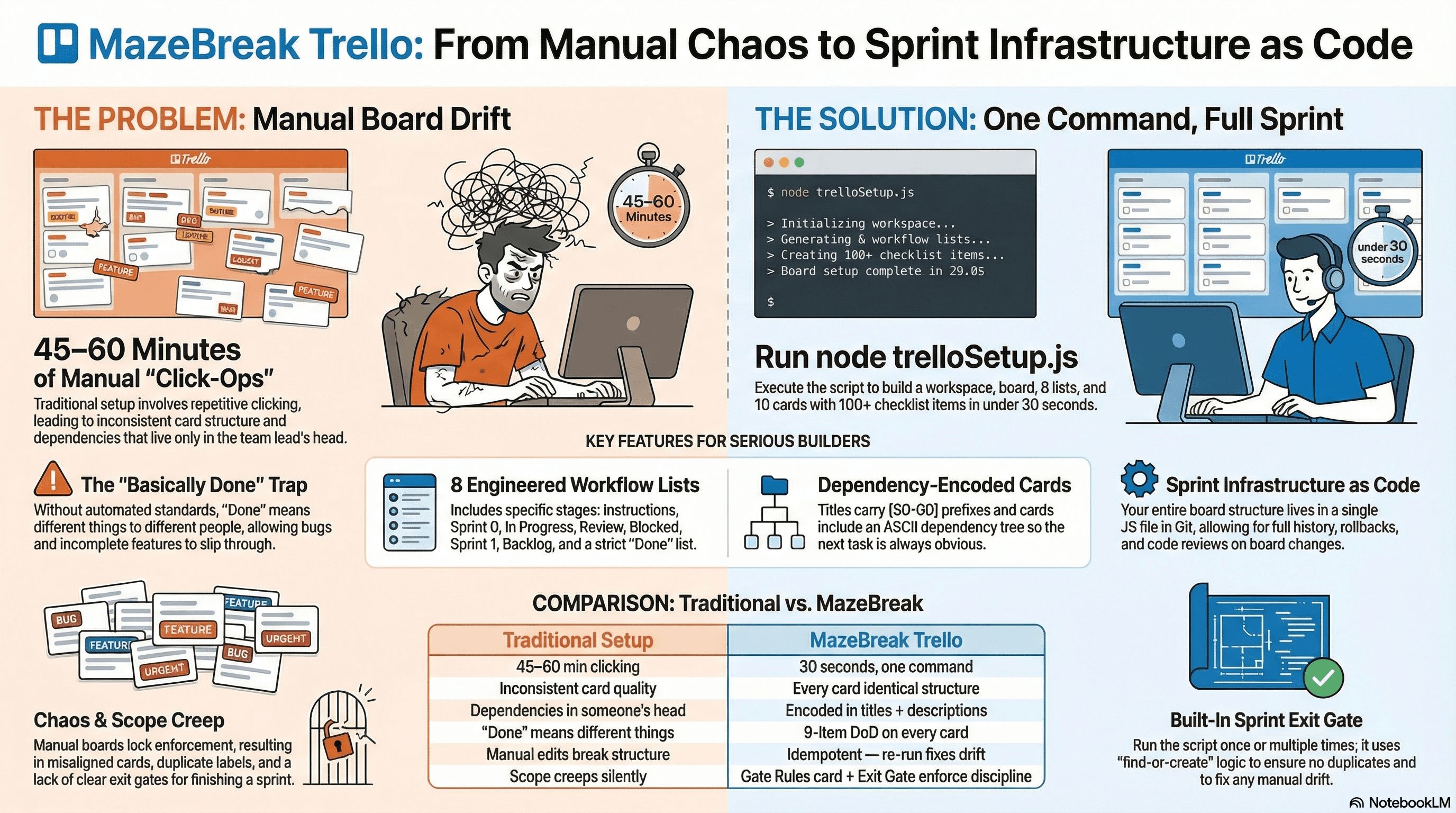
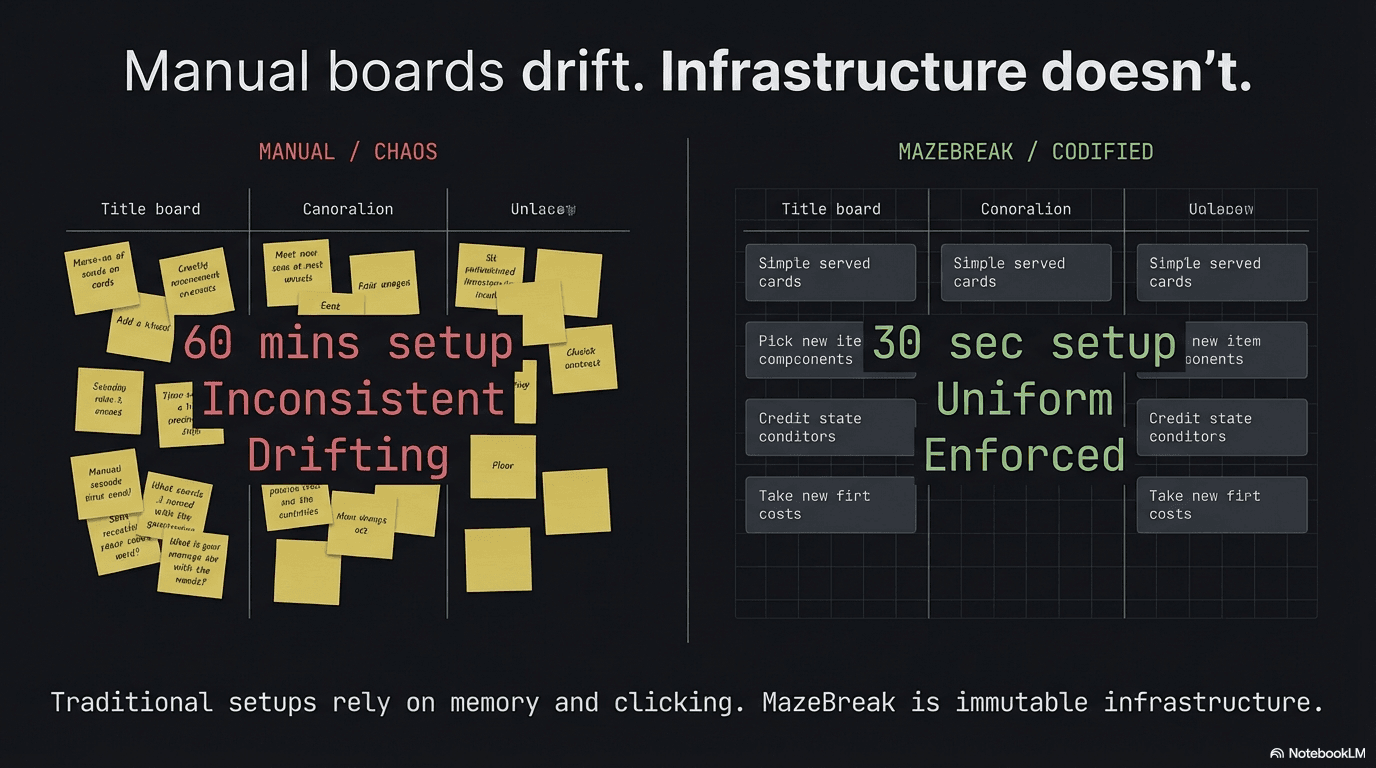
Game development teams lose days of productivity to manual sprint board setup — and the boards they build by hand are inconsistent, fragile, and impossible to replicate. Cards get created without checklists, acceptance criteria, or quality gates, so "done" becomes subjective and bugs leak into later sprints. Dependency chains between tasks exist only as tribal knowledge, leaving new team members guessing at execution order. When a board needs to be rebuilt for the next sprint or a new project, all of that structure has to be painstakingly recreated from memory.
The Solution
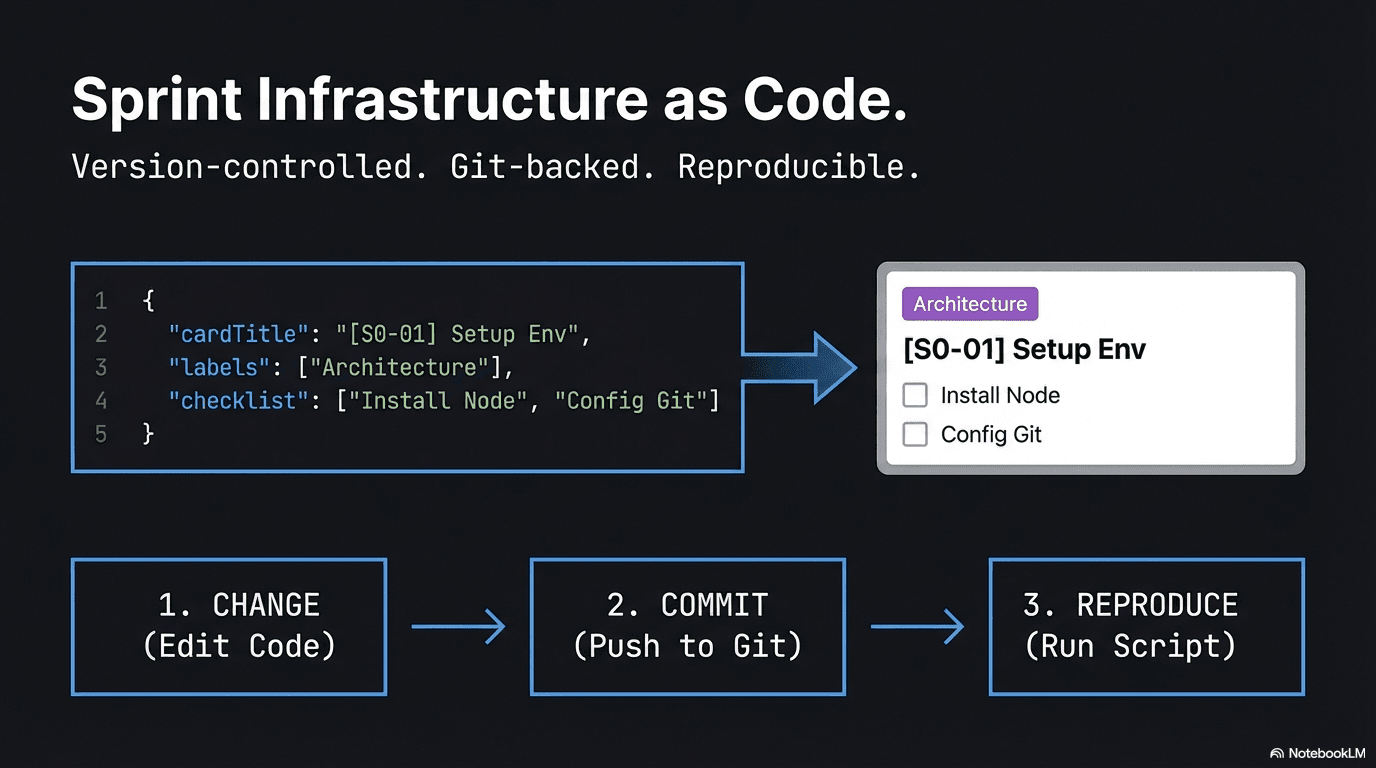
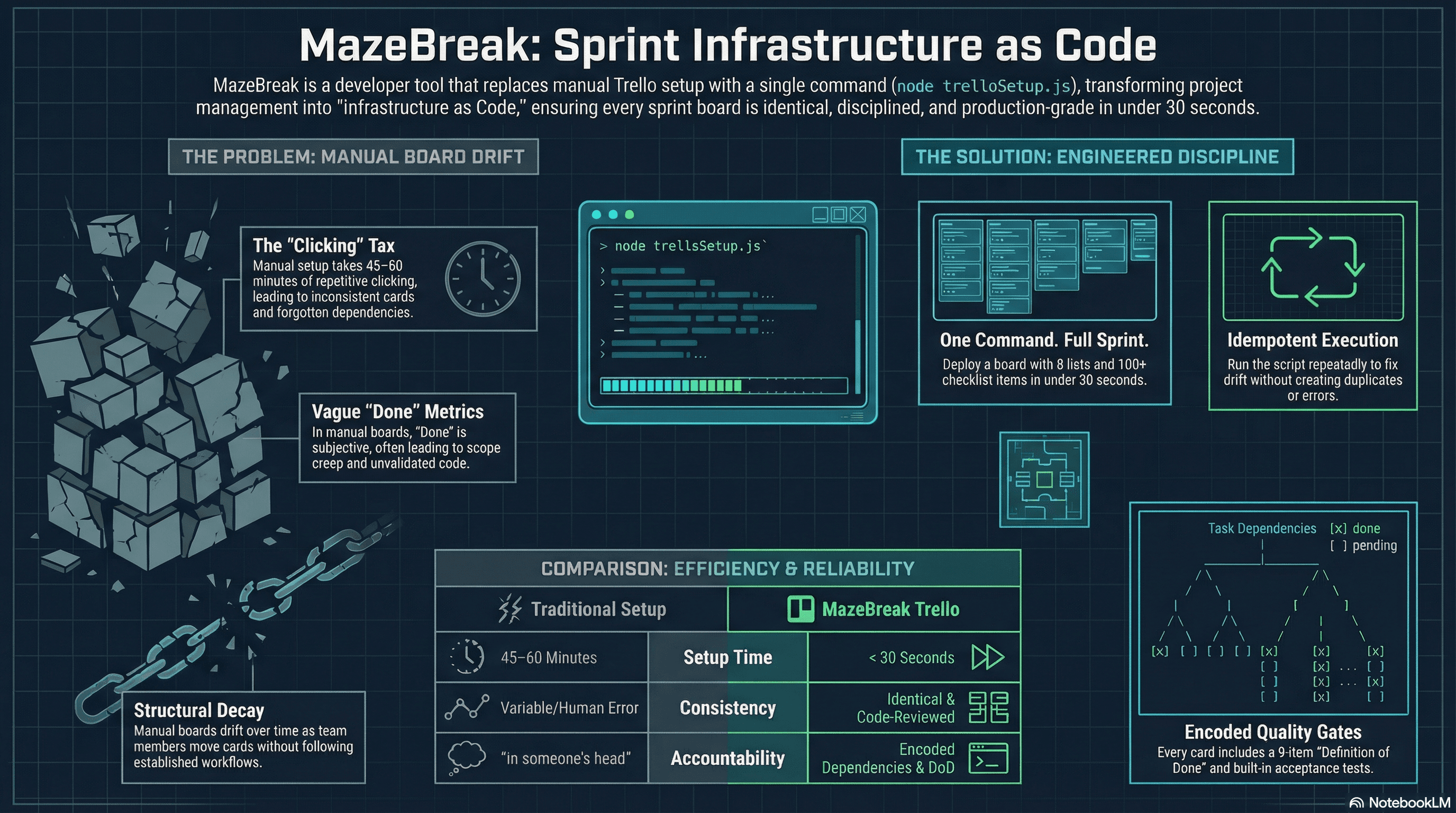
A single Node.js script provisions an entire sprint board through the Trello REST API, creating the workspace, board, workflow lists, color-coded labels, and ten fully-specified cards in one run. Each card ships with ordered execution checklists, acceptance tests, a global Definition of Done, and dependency prefixes that encode execution order directly into the structure. Every resource uses a find-or-create pattern, so the script is idempotent — running it twice produces the same board with no duplicates or errors. Cards are defined as a declarative data spec separated from the API logic, so adding work means adding an object rather than writing new API calls.
Results
Overview
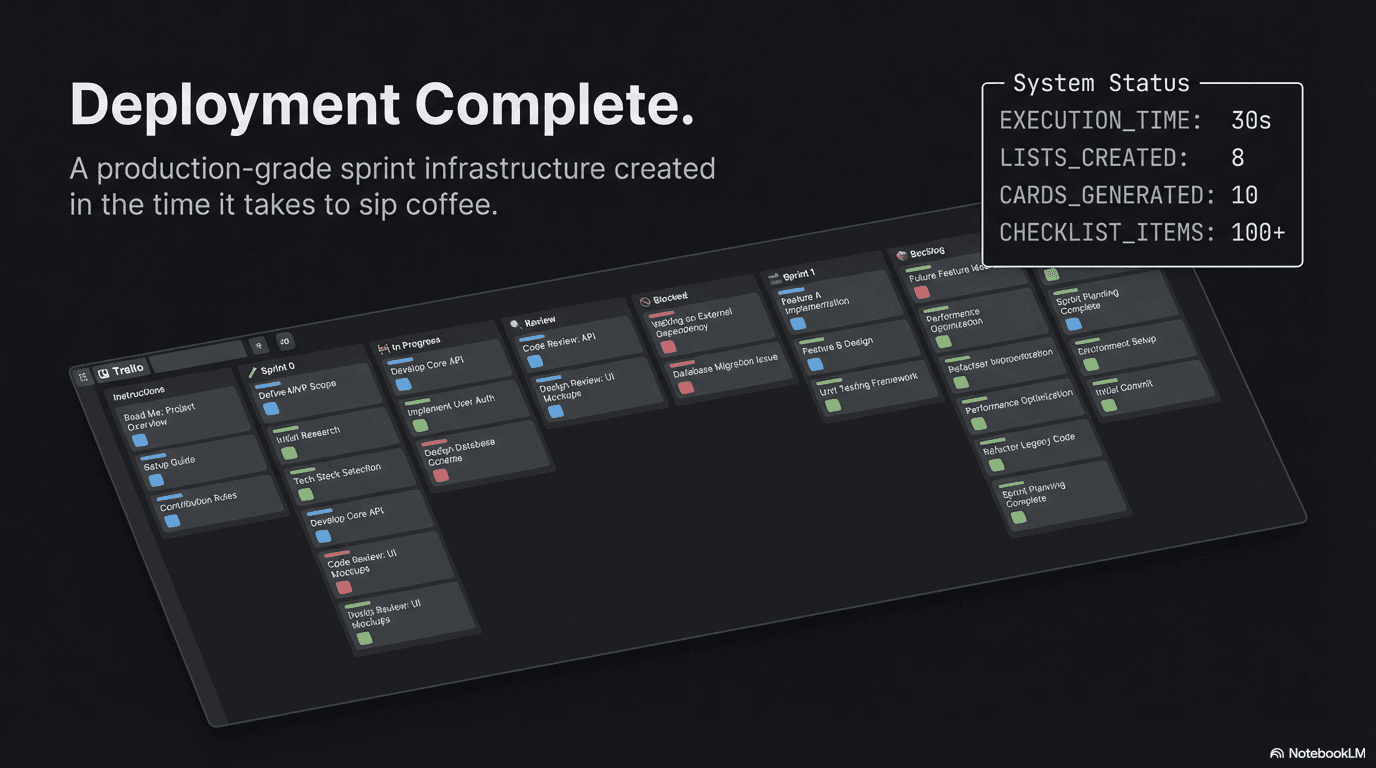
MazeBreak Trello is a Node.js automation tool that provisions a complete, production-grade sprint board via the Trello REST API. One command creates a workspace, board, workflow lists, color-coded labels, and 10 fully-specified sprint cards — each with ordered execution checklists, acceptance tests, a global Definition of Done, developer notes, and encoded dependency chains.
The tool also deploys a minimal Trello Power-Up connector on Vercel for future board integrations.
The Challenge
Manual Trello board setup creates compounding problems for sprint-driven game development:
- Inconsistent card structure: When cards are created by hand, some get checklists and acceptance criteria while others get a title and nothing else. Quality standards drift across the board.
- Lost dependencies: Card ordering and prerequisite relationships exist only in the creator's head. New team members or future sprints have no way to understand the intended execution sequence.
- No quality gates: Without a Definition of Done attached to every card, "done" becomes subjective. Cards move to the Done column without validation, and bugs surface in later sprints.
- Setup is not repeatable: If the board needs to be rebuilt, replicated for another sprint, or stood up in a new workspace, all the structure has to be manually recreated — including dozens of checklist items and descriptions.
- Developer context is missing: Architecture decisions, pitfalls, and implementation guidance live in separate documents (if they exist at all), disconnected from the cards where the work happens.
The Solution
The setup script addresses each problem with a code-first, API-driven approach:
Structured Cards with Encoded Dependencies:
- Every card title includes a dependency prefix (
[S0-00]through[S0-09]) - Card descriptions include a "Depends On" section listing prerequisite card IDs
- An instruction card on the board provides an ASCII dependency tree for quick reference
- Cards must be completed in order — the structure enforces discipline without requiring a human to police it
Consistent Quality Standards:
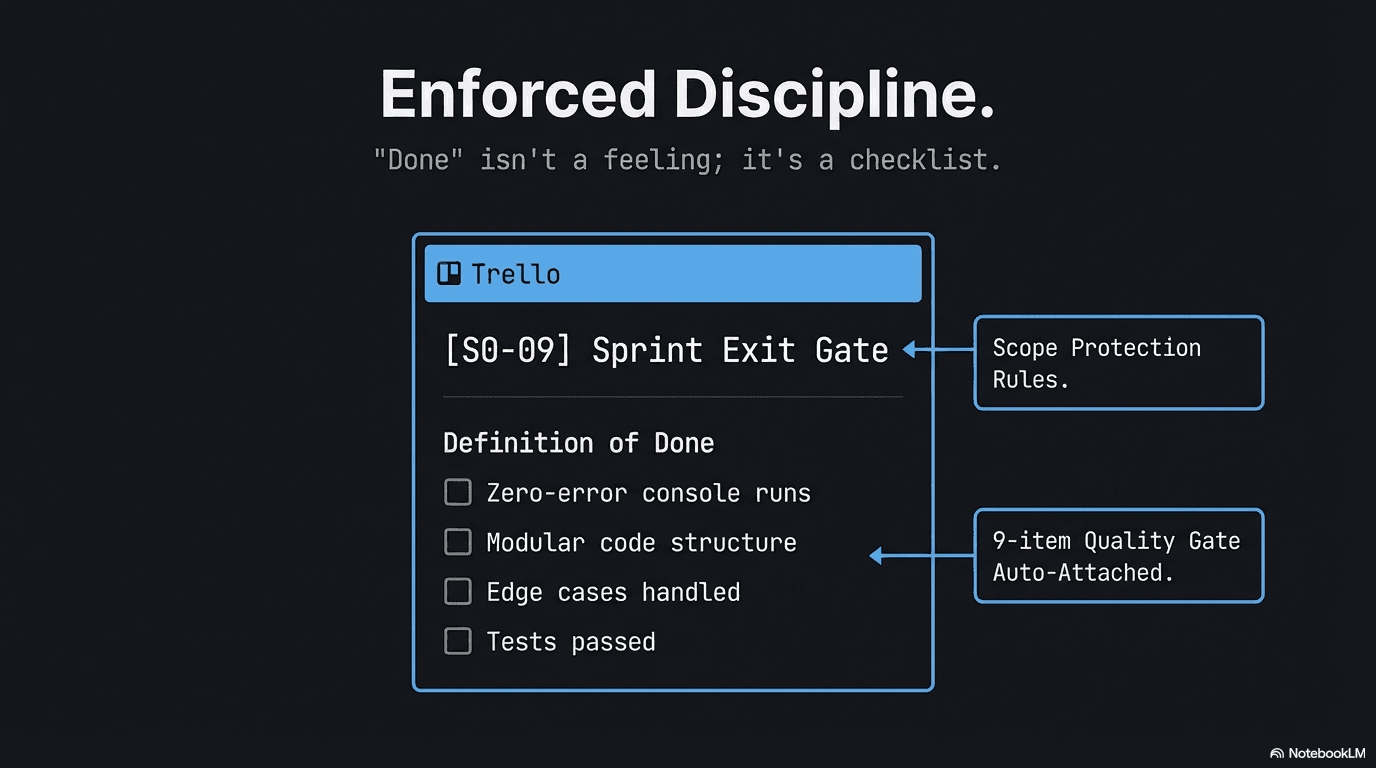
- Every card automatically receives a 9-item Definition of Done checklist covering zero-error runs, server authority, code modularity, edge case handling, and manual testing
- Execution checklists provide ordered implementation steps so nothing is skipped
- Acceptance test checklists define pass/fail criteria before a card can leave Review
Developer Notes as First-Class Content:
- Each card receives a comment with architecture pitfalls and implementation guidance
- Notes are attached as comments (not buried in descriptions) so they stay visible in the activity feed
- Guidance is card-specific — the Zombie card warns about AI loop performance, the DamageResolver card warns about hidden side effects
Idempotent by Design:
- Every resource (workspace, board, list, label, card, checklist, check item, comment) uses a find-or-create pattern
- Running the script twice produces the same board state — no duplicates, no errors
- Safe to use as a baseline reset or to add missing resources after manual changes
Workflow Lists for Real Sprint Tracking:
- 8 lists model the full card lifecycle: Instructions → Sprint 0 → In Progress → Review/Playtest → Done, with Blocked for stuck cards and Backlog for future work
- Instruction cards on the board explain how to move cards, when to update them, and keyboard shortcuts for efficient Trello use
Technical Highlights
- Trello REST API Integration: Full CRUD operations across organizations, boards, lists, labels, cards, checklists, check items, and comments — all authenticated via API key and token
- Idempotent Resource Management: Each helper function queries existing resources before creating, matching by name, color, or content prefix to prevent duplicates
- Axios Instance with Shared Auth: Centralized API client with base URL, timeout, and a
params()helper that injects credentials into every request - Fail-Loud Error Handling: Missing credentials trigger an immediate exit with a clear message. API failures surface the Trello error response body, not a generic stack trace.
- Declarative Card Spec: Sprint cards are defined as a data structure (title, labels, dependencies, description, checklists, dev notes) and iterated in a single loop — adding a card means adding an object, not writing new API calls
- Trello Power-Up Connector: Minimal
index.htmlinitializing the Trello Power-Up SDK, hosted on Vercel with SPA rewrites for future capability expansion
Results
For the Development Team:
- Sprint 0 board goes from zero to fully provisioned in under 30 seconds
- Every card has the same quality structure — no card is a second-class citizen
- Dependencies are visible and encoded, not tribal knowledge
- Developer notes surface architecture pitfalls at the point of work, not in a separate document
- Board can be torn down and rebuilt identically at any time
Technical Demonstration:
- REST API integration with full resource lifecycle management (create, read, update)
- Idempotent automation design — a pattern critical for infrastructure-as-code and CI/CD pipelines
- Data-driven architecture where the card spec is separated from the API execution logic
- Practical project management tooling that bridges the gap between planning and execution
- Environment-based credential management with validation and clear failure modes
This project demonstrates the ability to automate project management infrastructure through APIs, enforce consistent quality standards across a sprint board, and build tooling that is safe to re-run — a core principle in infrastructure automation, CI/CD, and DevOps workflows.
Ready to discuss a similar solution?
Let's explore how AI automation can help your business.
Schedule a Consultation